• I am a Scorpio: See How It Influences My Stories.

    I am a Scorpio: See How It Influences My Stories.

    A recent Instagram post from Margaret Atwood mentioned that Scorpio sun signs often make strong mystery writers. The moment I saw it, I smiled.

    As a Scorpio myself, it felt familiar.

    It also made me think about why I have always been drawn to write darker stories for young readers instead of lighter ones. While other people may naturally imagine sunshine, comedy, and cheerful adventures, my imagination has always wandered toward mystery, suspense, eerie settings, and the thrill of the unknown.

    Maybe part of that is personality. Maybe part of it is astrology. Either way, it inspired this blog.

    Growing Up Drawn to the Darker Side of Creativity

    Even as a child, I loved darker aesthetics.

    I loved spooky stories, scary movies, black nail polish, darker clothes, moody music, candlelight, storms, and anything mysterious. I loved the feeling of tension in a story and the excitement of not knowing what waited around the next corner.

    While some kids wanted bright worlds, I wanted haunted mansions, hidden passageways, abandoned carnivals, and strange noises in the night.

    That pull never left me.

    Why Scorpio Energy Fits Mystery Writers

    Whether you believe in zodiac signs or simply enjoy the symbolism, Scorpio traits are often described as curious, observant, intense, emotional, private, and fascinated by truth beneath the surface.

    That sounds a lot like a mystery writer.

    Writers of suspense and thrillers often ask:

    • What secret is being hidden?
    • Who is lying?
    • Why does this feel wrong?
    • What truth changes everything?

    Those are natural mystery questions. They are also questions that have always interested me.

    I do not usually write stories about perfect days and tidy endings. I want tension, atmosphere, and emotional stakes.

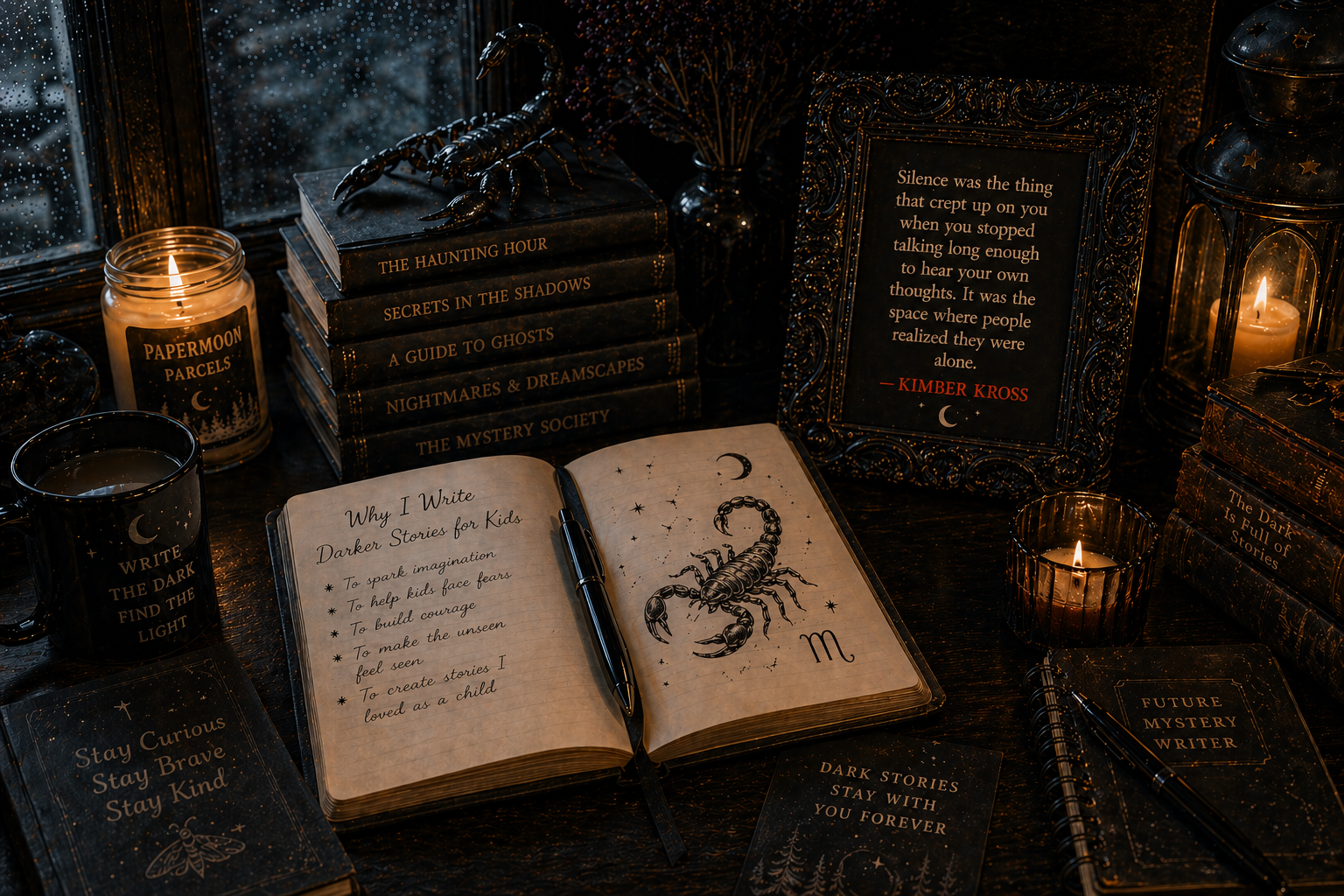
    Why I Write Darker Stories for Kids

    Children are not all the same. Some love humor and bright adventures. Others are drawn to suspense, mystery, and stories that let them feel brave.

    I write for those readers.

    Darker stories for kids are not about hopelessness. They are about courage. They are about friendship under pressure. They are about facing fear and discovering strength.

    A haunted house can teach bravery.
    A monster can represent fear.
    A mystery can reward curiosity.

    Dark stories often carry bright lessons.

    Why Some Readers Need These Stories

    When I was younger, I loved stories with shadows and suspense. They made me feel excited, curious, and fully engaged.

    I know there are readers today who feel the same way.

    They are the kids who love thunderstorms. The kids who choose Halloween over any other holiday. The kids who want the flashlight under the blanket and just one more chapter.

    Those readers deserve stories made for them.

    A Thank You to Margaret Atwood for the Spark

    That simple Scorpio comment on Instagram stayed with me. It reminded me that creative instincts often come from somewhere deep within us.

    Maybe being a Scorpio did shape some of my love for mystery, depth, intensity, and atmosphere.

    Maybe it simply gave language to instincts I already had.

    Either way, it inspired me to reflect on why I write what I write.

    Final Thoughts

    The world needs bright stories. It also needs moonlit ones.

    It needs cheerful adventures. It also needs creaking doors, strange clues, and brave kids who keep walking down the hallway.

    As for me, I will keep writing for the readers who feel most alive when the thunder starts.

    Maybe that is the Scorpio in me.

  • What Kids Notice in Scary Stories That Adults Completely Miss

    What Kids Notice in Scary Stories That Adults Completely Miss

    If you’ve ever read a spooky story alongside a child, you’ve probably noticed something interesting:

    You’re focused on the big moments.
    The twist.
    The reveal.
    The “what’s actually happening” behind it all.

    But kids?

    They’re paying attention to something completely different.

    And once you see it, you can’t unsee it.


    They Don’t Start With Logic—They Start With Feeling

    Adults want answers.

    We try to figure things out:

    • Is the house actually haunted?
    • Is there a real explanation?
    • Where is this going?

    Kids don’t do that.

    They don’t need everything to make sense right away.

    Instead, they ask:

    • Why does this feel weird?
    • Why did the room suddenly feel different?
    • Why did that part give me chills?

    They experience the story before they analyze it.

    And that changes everything.


    They Notice the Smallest, Strangest Details

    Adults often focus on plot.

    Kids focus on moments.

    The tiny things.

    • The window that was closed… now slightly open
    • The sound that wasn’t there before
    • The feeling that someone is watching—even if no one is

    These details might seem minor to an adult reader.

    To a kid?

    That’s the story.

    That’s where the tension lives.


    They Sit in the Unknown Longer

    Most adults rush toward resolution.

    We want clarity. Closure. Answers.

    Kids are far more comfortable sitting in uncertainty.

    They’ll linger in that space where:

    • You don’t know what’s out there
    • You’re not sure what’s real
    • Something feels off—but you can’t prove it

    And honestly?

    That’s where the best suspense lives.


    They Make It Personal

    Here’s the part that makes spooky stories stick:

    Kids don’t just read the story.

    They place themselves inside it.

    They think:

    • What would I do?
    • Would I go down the hallway?
    • Would I open the door?

    The story doesn’t stay on the page.

    It follows them.

    (In the best way.)


    Why This Matters for the Stories I Write

    When I write for Papermoon Parcels, I don’t write with an adult lens.

    I write for the reader who notices:

    • The flicker of light
    • The shift in silence
    • The feeling that something isn’t quite right

    Because that’s where the magic happens.

    Not in over-explaining.

    Not in making everything obvious.

    But in building a story that lets the reader feel their way through it.


    The Real Secret to a Great Scary Story

    It’s not about how frightening something is.

    It’s about how long you can hold someone in that moment of:

    “Wait… did that just happen?”

    Kids understand that instinctively.

    They don’t rush past it.

    They sit in it.

    And that’s exactly why spooky stories work so well for them.


    Final Thought

    Adults read to understand.

    Kids read to experience.

    And when a story does both?

    That’s when it becomes unforgettable.

  • Why Books Matter More Than Ever in a Scroll-Obsessed World

    Why Books Matter More Than Ever in a Scroll-Obsessed World

    A child can scroll for hours without realizing it.

    At first, one video turns into ten. Then ten turns into fifty. Before they know it, the time is gone.

    However, hand that same child a book and say,
    “Just read for ten minutes…”

    …and suddenly, it feels like work.

    So what changed?


    The World Got Faster

    Today’s world is built for speed.

    With short-form videos, instant entertainment, and endless scrolling, everything is designed to capture attention immediately—and replace it just as quickly.

    Because of this, kids growing up in this environment aren’t used to slowing down. As a result, reading can feel unfamiliar at first.

    After all, reading asks something different.

    It asks you to stay.


    Why Reading Still Matters for Kids

    Books offer something screens simply cannot replicate.

    Instead of passively watching, a child becomes part of the story. They imagine the setting, feel the tension, and follow the characters step by step.

    In contrast to screens, there are no distractions. There’s no skipping ahead or jumping between moments.

    Instead, the story builds—page by page.

    Because of this, reading strengthens focus in a way that matters now more than ever.


    The Truth: Kids Don’t Dislike Reading

    Kids don’t hate reading.

    Rather, they dislike stories that don’t hold their attention.

    Once a story does hook them, everything changes.

    Suddenly, time disappears. They stop reaching for distractions. Instead, they keep going—not because they have to, but because they need to know what happens next.

    That’s the difference.

    Not reading vs. screens.

    But engaging vs. forgettable.


    Why Suspense, Action, and Adventure Matter

    When I sit down to write, I focus on one thing above all else:

    Not just what happens…

    …but what makes a reader keep turning the page.

    This is where suspense, action, and adventure come in.

    Moments where something feels slightly off.
    Choices that matter.
    Situations that make the reader pause and think:

    “Wait… what would I do?”

    Because that’s what draws a reader in.

    More importantly, that’s what keeps them there.

    And in today’s world full of distractions, that kind of storytelling isn’t optional.

    It’s essential.


    Books vs. Screens: A Different Kind of Experience

    Screens move quickly.

    Books, on the other hand, go deeper.

    While scrolling delivers constant change, reading creates sustained immersion.

    When a child gets lost in a book, they’re no longer jumping between moments—they’re living inside one.

    They build the world in their imagination. They stay with the story. They experience the tension as it unfolds.

    As a result…

    everything else fades away.


    Give Kids a Reason to Put the Screen Down

    The goal isn’t to eliminate screens.

    That’s neither realistic nor necessary.

    Instead, the goal is to offer something just as compelling.

    A story that captures attention.
    A story that sparks curiosity.
    A story that makes a child forget to check what’s next.

    Because when that happens…

    they don’t need to be told to read.

    They choose to.


    Final Thought

    In a world that never stops scrolling…

    the right story can still make a child stop.

    Not because they have to.

    But because they’ve found something better.

    Something that pulls them in, keeps them engaged, and stays with them long after the final page.

    And ultimately, that’s exactly the kind of story worth writing.